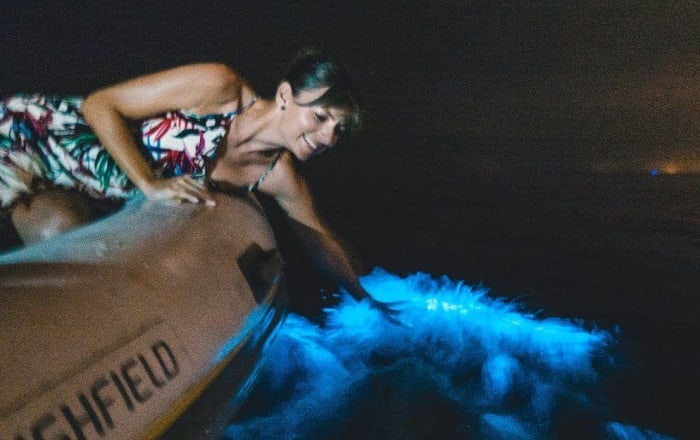
Can you photograph bioluminescence? Honest tips

It is the first question many people ask us after "can I swim?": can I take a picture of it? The honest answer is yes, sometimes, with the right gear and a lot of patience. But the glow you see with your own eyes at Manialtepec Lagoon is almost always brighter, wider and more alive than anything you will bring home on a screen. Here is what works, what doesn't, and how to decide whether it is worth trying.
Why bioluminescence is so hard to photograph
The light comes from tiny single-celled organisms that flash for a fraction of a second when the water moves. Each flash is faint, it is gone almost instantly, and it happens in near-total darkness. That combination is about the worst possible situation for a camera:
- Very little light. To collect enough of it, the camera needs a long exposure, often several seconds.
- Everything moves. The boat rocks, the water ripples, people shift around. A long exposure on a moving boat turns into a blur.
- The glow is brief. By the time the shutter opens, a single splash may already be dark again.
Your eyes, once they have adjusted to the dark, handle this far better than any sensor. That is why the photos you see online are usually long exposures taken from a fixed spot, sometimes edited, and rarely look exactly like the real thing.
Can a phone photograph bioluminescence?
A recent phone with a good night mode can catch something: a blue smudge where a paddle hit the water, a few sparkles around a hand. Older phones, or phones without night mode, usually show a black frame. If you want to try with your phone:
- Turn on night mode and let it run the longest exposure it offers.
- Turn off the flash. Flash lights up the surface of the water and kills the glow completely.
- Brace the phone. Rest it on the edge of the boat or on your knee and hold your breath during the exposure. Any movement smears the light.
- Make the water move during the exposure. Ask someone to sweep a hand slowly through the water while the shutter is open. Slow, steady movements leave longer trails than splashes.
- Turn your screen brightness down. A bright screen ruins your own night vision and that of everyone on the boat.
Video is even harder. Most phones produce a dark, grainy clip in which you can barely tell where the glow is. If a video is what you want, keep your expectations low.
What about a real camera?
A camera with a large sensor and good high-ISO performance gives you a much better chance. If you are bringing one, these are reasonable starting points, to adjust on the spot:
- Lens: the widest and brightest you own (f/1.4 to f/2.8 is ideal).
- ISO: high, often 3200 to 6400 or more, depending on how much noise your camera handles.
- Shutter speed: start around 2 to 4 seconds and adjust. Longer exposures gather more glow but also more blur, since the boat is never fully still.
- Focus: manual. Autofocus will hunt in the dark. Focus on a light on the shore before it gets fully dark, or use the focus distance marks.
- File format: shoot RAW so you can pull detail out of the shadows later.
- Stabilization: a tripod is not much use on a rocking boat. A small beanbag, or simply pressing the camera against the boat, works better.
Even with all of this, expect a lot of missed frames. Photographers who get great shots of bioluminescence usually go back several nights in a row.
The night itself matters more than the gear
The single biggest factor in a good photo is how bright the glow is that night. It is strongest on the darkest nights, around the new moon, and the lagoon is often at its brightest during the rainy season, roughly June to October. A full moon makes the glow fainter to the eye and almost invisible to a camera. Clouds and light from the shore play a part too. If photos are important to you, pick your date with the moon in mind.
Protect your gear (and the lagoon)
- Bring a dry bag or a waterproof pouch. You'll be getting in and out of the water, and things on a boat get wet.
- Don't take your phone swimming unless it is in a case you really trust. Lagoon water and dropped phones don't mix, and you can't look for one in the dark.
- No flashlights or headlamps pointed at the water. Bright light ruins everyone's night vision, including yours.
- Remember the no-sunscreen, no-repellent rule. Chemicals on your skin harm the plankton that create the glow, so arrive without them. Repellent goes on after the swim.
Should you even try?
Our honest advice: take a couple of shots early on, see what your phone or camera gives you, and then put it away. The tour includes about an hour on the water, and the best part is the swim, which you can't photograph anyway unless you have a waterproof camera and someone to hold it. Many guests tell us the moments they remember most are the ones they didn't try to film: watching their hands trail blue light, or a fish streaking under the boat like a tiny comet.
If you want something to remember the night by, a photo of your group on the boat at dusk, or of the stars on the way back, is usually easier to get and just as meaningful.
Quick answers
Will a GoPro or action camera work?
Most action cameras have small sensors that struggle badly in very low light. Some newer models have night settings, but in practice the glow usually comes out faint or not at all.
Does flash help?
No. Flash lights up the surface and completely hides the glow. Turn it off.
Are the photos I see online real?
Many of those images are long exposures taken from land, stacked or edited. They are beautiful, but don't treat them as a promise of what your phone will capture.
If you want to give your camera the best possible conditions, start with the calendar: our guide to bioluminescence and the moon explains how to choose the darkest night for your trip.