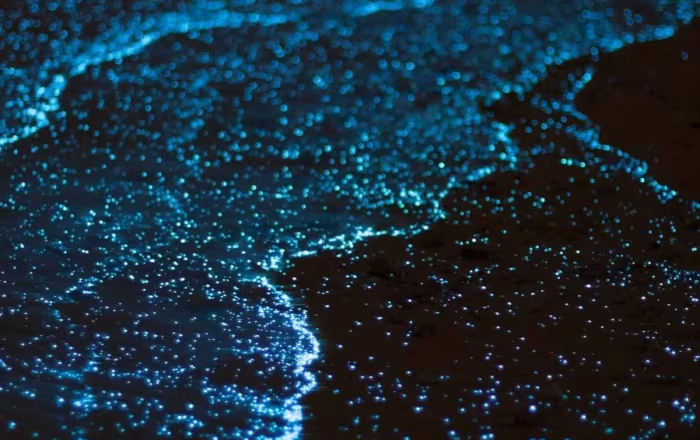
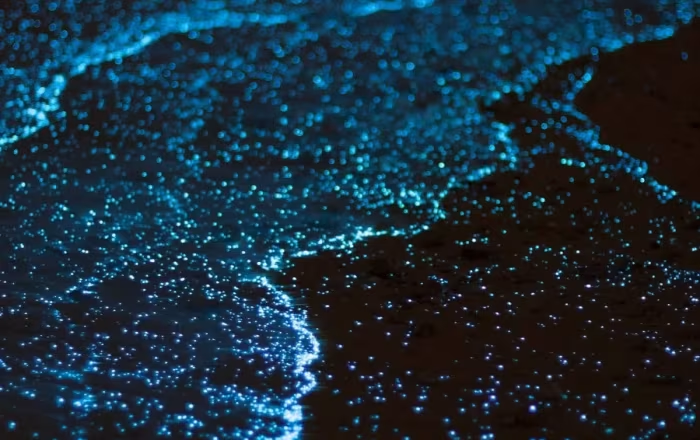
Why is bioluminescence blue? The science behind the lagoon's color
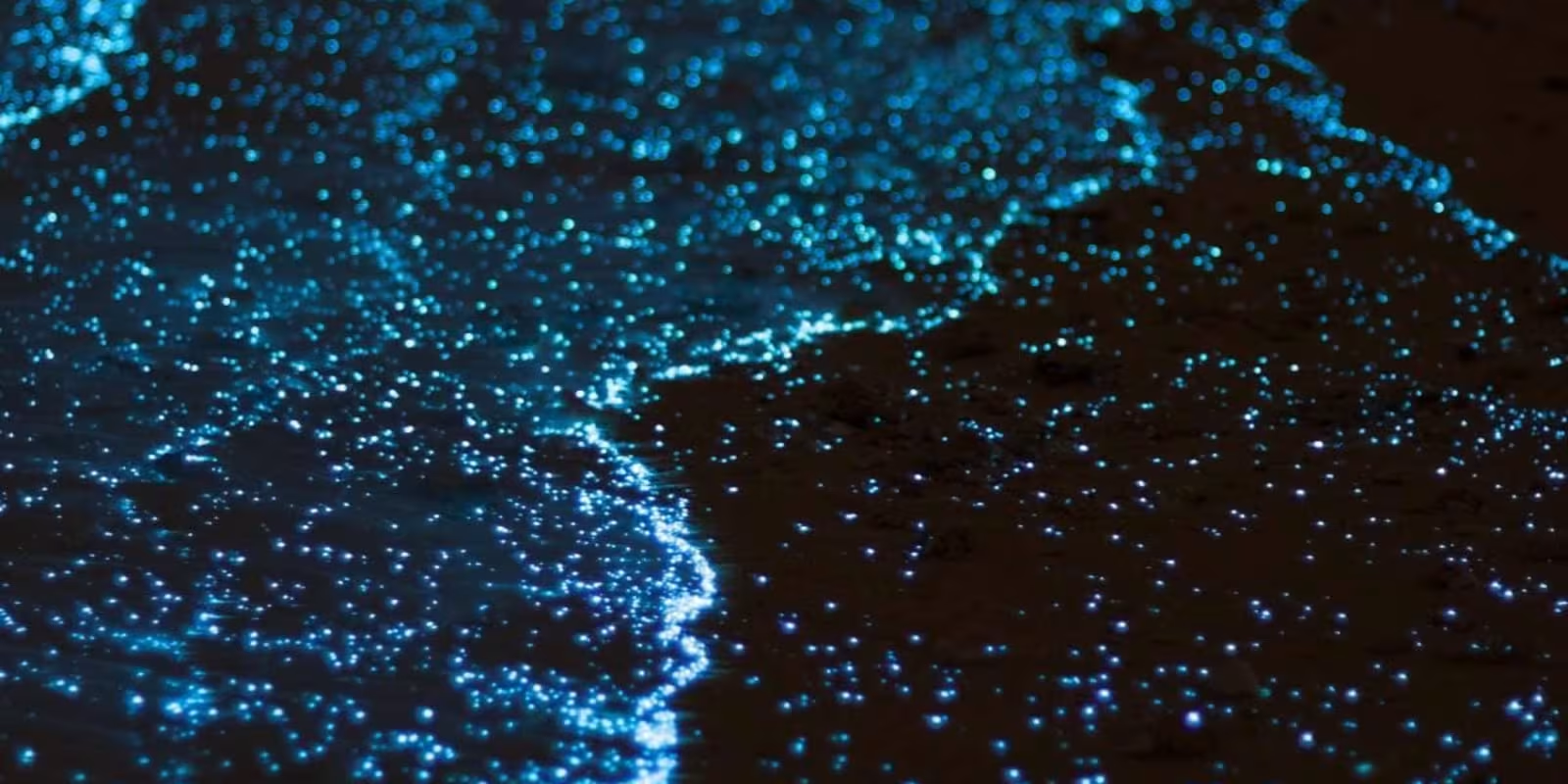
Ask anyone who has been out on Manialtepec Lagoon at night to describe the glow, and the first word is almost always "blue". Electric blue, neon blue, a blue that looks fake in photos. It is a fair question to ask why. Fireflies glow yellow-green, glow sticks come in every color, so why does the light in the water come out blue nearly every time?
The short version: blue is the color that travels farthest through seawater, so over millions of years most marine glowing organisms evolved to make blue light, and most sea creatures evolved eyes tuned to see it. The plankton in the lagoon follow the same rule. Your own night vision then does the rest.
Light in water: why blue wins
Sunlight contains every color, but water does not let them all through equally. Red light is absorbed within the first few meters, which is why a red swimsuit looks dull brown when you dive. Orange and yellow go next. Blue and blue-green light penetrate the deepest, which is also why the open ocean looks blue in the first place.
For an animal that makes its own light, that matters a lot. Light costs energy to produce, and a signal that dies after a few centimeters is wasted. A blue flash reaches farther, so it works better for whatever the light is for: startling a predator, attracting prey, finding a mate or hiding a silhouette against the faint light from above. NOAA's National Ocean Service sums it up in one line: marine bioluminescence is usually blue because that is the light that travels best through water.
There is a second half to the story. Because blue is what reaches them, most marine animals have eyes that are most sensitive to blue and blue-green, and many deep-sea species can't see red at all. Producing a color that nobody around you can see would be pointless, so evolution pushed both the light and the eyes toward the same narrow band.
The chemistry behind the blue
All bioluminescence comes from the same basic recipe: a light-emitting molecule called luciferin reacts with oxygen, helped by an enzyme called luciferase, and the energy leaves as visible light. Our post on bioluminescence vs fluorescence explains that reaction in more detail.
What decides the color is the exact shape of those molecules. Different groups of organisms use different luciferins, and each one releases its energy at a slightly different wavelength. The dinoflagellates that light up the lagoon have their own type of luciferin, and their flash sits in the blue part of the spectrum, close to the wavelengths that travel best in water. In other words, the plankton aren't blue by accident: their chemistry is tuned to the same color the ocean favors.
The color isn't fixed by the molecule alone, either. Some animals filter their light, pass it through lenses, or use a second protein to shift it. The jellyfish famous for green fluorescent protein makes blue light first and then converts it to green. Small tweaks like these explain the range from violet to green that scientists find in the sea.
Why fireflies glow yellow-green instead
On land, the rules change. Air doesn't filter out red and yellow the way water does, so there is no pressure to stay blue. Fireflies glow yellow-green, a color that stands out well against dusk and leaves, and that their own eyes see best. Glowing mushrooms and some land insects also lean green.
Shallow coastal water sits somewhere in between. It carries more sediment, plankton and dissolved plant material than the open ocean, which shifts the best-traveling color slightly toward green. That is one reason some glowing animals near the coast give off a greener light than their deep-sea relatives.
The rare exceptions: red, green and yellow
Blue is the rule, not the law. A few deep-sea dragonfishes produce red light and are among the very few fish that can see it. Since almost nothing else down there can detect red, they get a private searchlight to spot prey without being noticed. Some marine worms and snails glow green or yellow, and certain squid mix colors. These are curiosities, though. If you see glowing water in a lagoon or along a beach, it will almost certainly be blue or blue-green.
Why the lagoon looks so intensely blue to you
Part of the answer is in your own eyes. In very dim light, the color-sensing cones in your retina switch off and the rod cells take over. Rods are most sensitive to blue-green light. So once your eyes have adjusted to the dark on the boat, they are at their most sensitive to exactly the color the plankton produce. That is why a glow that measures as faint looks so vivid in person.
It also explains some of the practical advice we give on the tour:
- Let your eyes adapt. Night vision takes a while to build up. Avoid looking at bright phone screens on the way, and the glow will look noticeably brighter after a few minutes on the dark water.
- Darker nights look bluer. Moonlight wakes up your cones again and washes out the faint blue sparks. Our moon phase guide helps you pick a night with better contrast.
- Photos may show a different blue. Cameras don't see the way your rods do. Depending on white balance and processing, the same glow can come out cyan, deep blue or almost green, and long exposures often look brighter than reality. Our bioluminescence photography tips explain how to get closer to what you saw.
Quick answers
Is all bioluminescence blue?
No. Most marine bioluminescence is blue or blue-green, but on land green and yellow are common (fireflies, some fungi), and a few deep-sea fish produce red light.
Is the glow at Manialtepec always blue?
The plankton in the lagoon produce blue light. To the eye it usually reads as bright blue or blue-white; in photos it can look more cyan or greenish depending on the camera.
Why don't the plankton glow all the time?
They only flash when the water around them is disturbed, so still water looks black. Move a hand or a paddle and it sparks. Our guide to what makes Manialtepec Lagoon glow covers the plankton themselves.
Is blue bioluminescence the same as blue fluorescence?
No. Fluorescence needs a light shining on it, like a UV lamp. Bioluminescence makes its own light in complete darkness, which is why the lagoon glows best on the darkest nights.
Now that you know why the light is blue, see how it compares with the other kinds of glow in bioluminescence vs fluorescence vs phosphorescence.