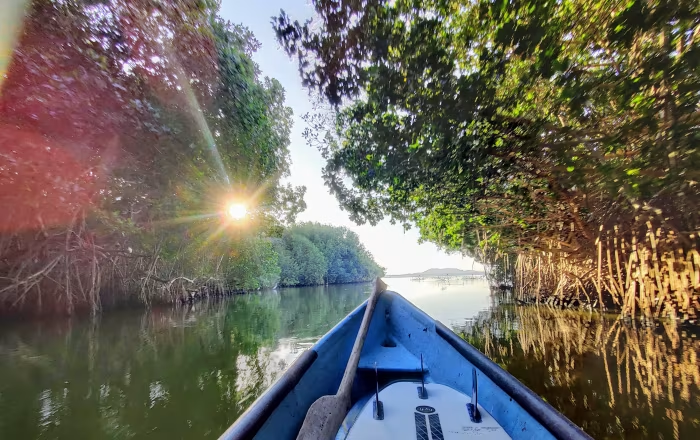
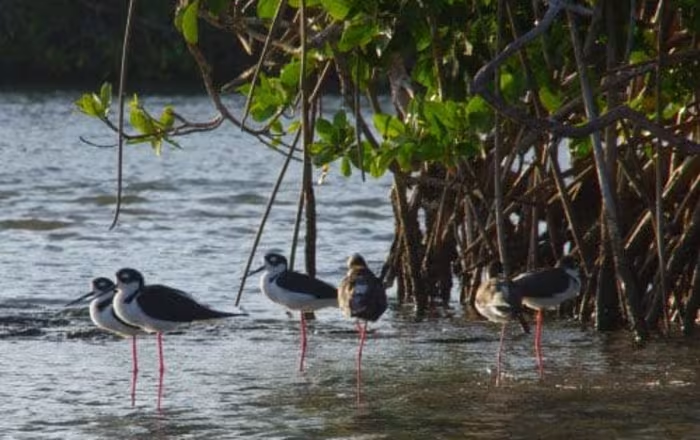
Why Oaxaca's mangroves matter (and why they glow)

On the night tour, the mangroves are mostly a dark wall at the edge of the lagoon. You hear them more than you see them: a heron complaining, water lapping at the roots, a fish jumping somewhere close. Yet those trees are a big part of the reason the water lights up when you move your hand through it. Here is what the mangroves of Oaxaca are, where you can see them around Puerto Escondido, and why they matter far beyond one glowing night.
What is a mangrove, exactly?
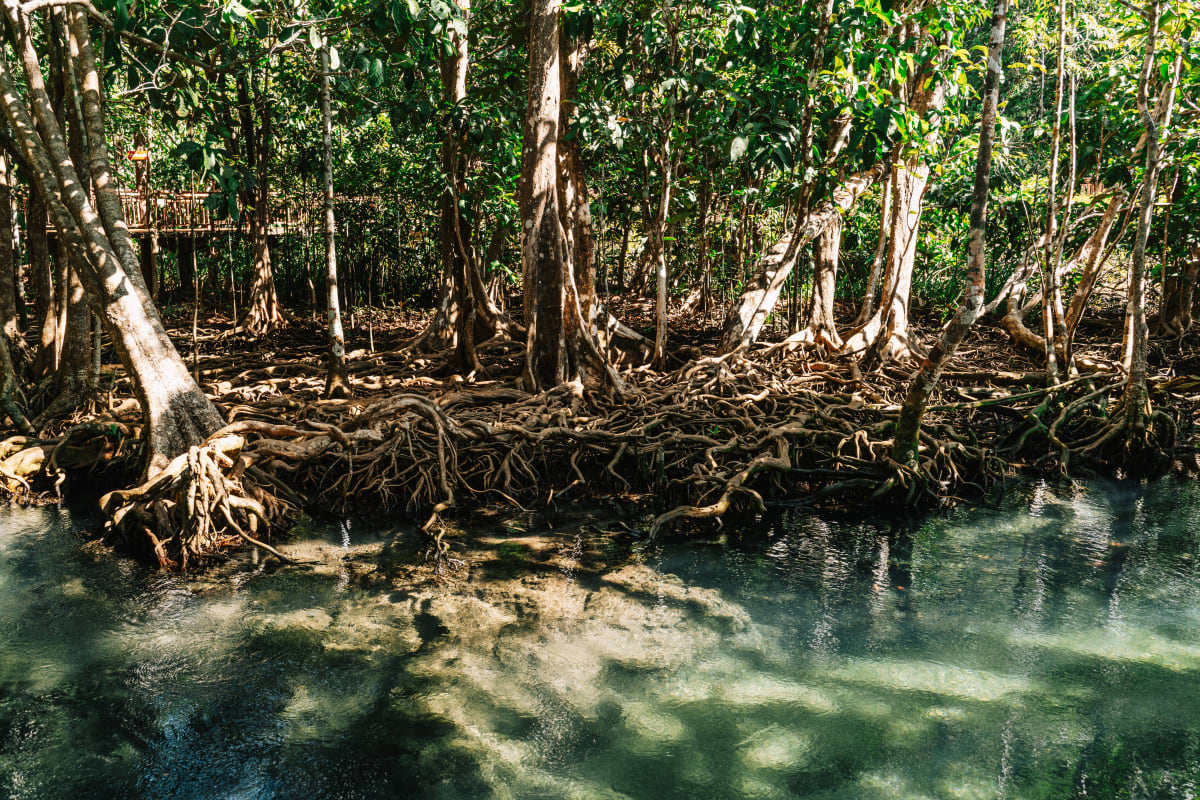
A mangrove is not a single species. It is a group of trees and shrubs that have learned to live where almost nothing woody can: in salty or brackish water, in soft mud that floods and drains with the tides and the seasons. They manage it with a few tricks, such as filtering salt out at the roots, pushing extra salt out through their leaves, and growing roots that breathe above the waterline.
According to CONABIO, Mexico's biodiversity commission, four species dominate the country's mangroves, and you can find them on the Oaxacan coast:
- Red mangrove (Rhizophora mangle): the one closest to the water, standing on arching stilt roots. It forms the tunnels you pass through by boat.
- Black mangrove (Avicennia germinans): surrounded by pencil-like roots that poke up out of the mud to take in air.
- White mangrove (Laguncularia racemosa): usually a little further back, on ground that floods less often.
- Buttonwood (Conocarpus erectus): the most landward of the four, where the mangrove meets dry ground.
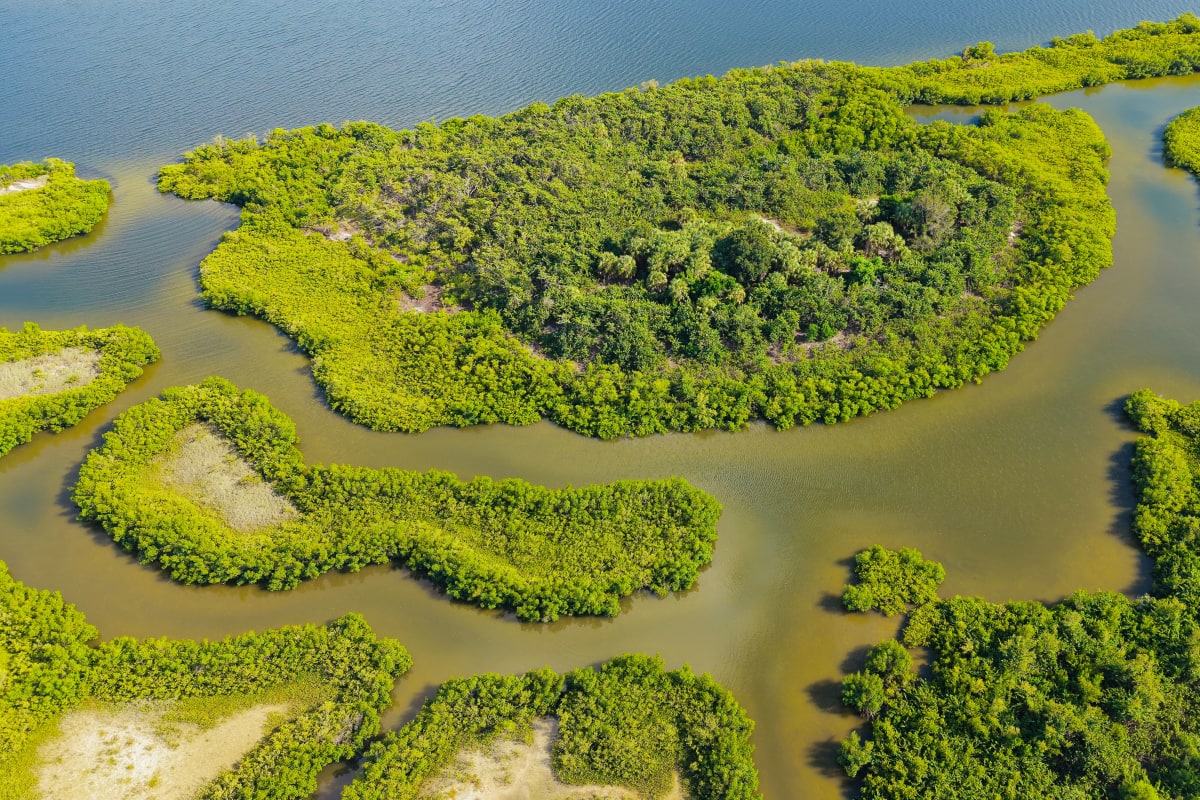
Mexico has around 6% of the world's mangroves, which puts it fourth worldwide, after Indonesia, Australia and Brazil. Most of that area is on the Gulf and Yucatán coasts, but the Pacific side, Oaxaca included, has a string of smaller mangrove lagoons that are just as important locally.
Where to see mangroves near Puerto Escondido
The coast between Puerto Escondido and the Guerrero border is a chain of coastal lagoons, each separated from the Pacific by a sandbar and lined with mangroves. Three are easy to reach:
- Manialtepec Lagoon, about 20 minutes west of town. Mangrove channels, plenty of birds by day and, after dark, the bioluminescence our tour is built around. Our Manialtepec Lagoon guide covers it in detail.
- The Chacahua lagoons, further west inside Lagunas de Chacahua National Park, protected since 1937. Bigger, wilder and a longer day out.
- La Ventanilla, near Mazunte to the east, where a local community runs small boat trips through its mangrove lagoon, known for its crocodiles and birdlife.
Why mangroves matter
Mangroves are easy to overlook. From the road they look like a tangle of green scrub. But in this part of Oaxaca they do a lot of quiet, practical work.
They are a nursery for the sea
The submerged roots are full of hiding places. Young fish, shrimp and crabs grow up among them, protected from bigger predators, before moving out into the lagoon and the open ocean. Many of the fish that end up on plates in Puerto Escondido's beach restaurants, and in the nets of the families who fish the lagoons, spend part of their lives in the mangroves.
They hold the coast together
The dense roots trap sediment and slow down moving water. That stabilises the lagoon banks, keeps the water clearer and softens the impact of storm surges and floods on the communities behind them. On a coast that sees hurricanes and heavy summer rains, that buffer counts.
They feed the birds
Herons, egrets, ibises, kingfishers and ospreys all depend on what the mangroves produce. At sunset you can watch flocks fly in to roost in the branches. If birds are your thing, our Manialtepec birdwatching guide lists what to look for.
They store carbon
Mangrove soils are waterlogged and low in oxygen, so dead leaves and roots break down slowly and a lot of carbon stays locked in the mud for a long time. That is why mangroves come up so often in conversations about "blue carbon" and climate. Clearing them releases that carbon again.
So why do mangrove lagoons glow?
The light itself comes from dinoflagellates, single-celled plankton that flash when the water around them moves. We explain the chemistry in what makes Manialtepec Lagoon glow. These plankton live in oceans all over the world, though. What the mangroves add is the right setting for them to gather in large numbers:
- Food. Mangroves drop leaves all year. As those leaves break down in the water they release nutrients that feed the plankton.
- Shelter. A lagoon fringed by mangroves is calm and enclosed. The water is not constantly flushed out to sea, so the plankton stay concentrated instead of drifting away.
- Warmth. Shallow, sheltered lagoon water warms up quickly, which suits many of these organisms.
- Darkness. The trees screen the lagoon from what little light there is on the coast, so even a faint glow is easy to see.
It is no coincidence that several of the best-known glowing bays in the world, including the ones in Puerto Rico, are also surrounded by mangroves. Researchers there have long pointed to the mangroves as part of what keeps the glow going. The rainy season adds another push: runoff from the hills brings extra nutrients, and in most years Manialtepec is at its brightest from roughly June to October.
What threatens them
Mangroves worldwide have been cleared for shrimp farms, roads, ports, hotels and housing, and Mexico is no exception. On the Oaxacan coast the pressures are more local: filling in lagoon edges to build, cutting wood, rubbish and sewage reaching the water, and changes to how rivers and sandbars behave. Because of this, all four of Mexico's main mangrove species are listed as threatened under the country's official endangered species standard, and federal law forbids removing or filling mangroves. CONABIO also keeps a national mangrove monitoring system to track how much is left.
Lose the mangroves and you lose much more than the trees: the fish nursery, the birds, the protection from floods and, very likely, the glow.
How visitors can help
- Go with local boat crews. They know the channels, steer around the roots and keep engines low in sensitive areas, and the money stays with the families who look after the lagoon.
- Don't pull at roots or branches when the boat passes close, however tempting it is to grab one.
- Skip sunscreen, lotion and repellent before a night swim. They harm the plankton. Apply repellent once you are out of the water.
- Take your rubbish back with you. Plastic caught in mangrove roots stays there for years.
- Keep it quiet near roosting birds, especially at dusk.
Quick answers
Are there crocodiles in Oaxaca's mangroves?
Yes, crocodiles live in several of the coast's lagoons. They are shy and keep to quiet edges and back channels, away from boats and people. Local crews know where they are and where it is fine to swim.
Can I see the mangroves on the night tour?
Only as silhouettes. The shared tour starts after dark, so if you want to see the mangroves in daylight, come back in the morning or choose the private tour, which picks you up at 5:30 PM and includes sunset on the water.
Is it OK to swim among mangroves?
On a guided tour, yes: the crew chooses a calm, open spot and you get a life jacket. Don't swim in mangrove lagoons on your own at night.
Weighing up where to go? Our comparison of Chacahua vs Manialtepec for bioluminescence looks at both mangrove lagoons side by side.