What time of night is bioluminescence brightest?

Bioluminescence becomes clearly visible once the sky is fully dark, roughly 45 minutes to an hour after sunset, and it can be seen at any point of the night after that. There is no single magic hour. The best time on any given evening is when three things line up: it is properly dark, the moon is not lighting up the sky, and your eyes have had time to adjust.
Why you can't see it before dark
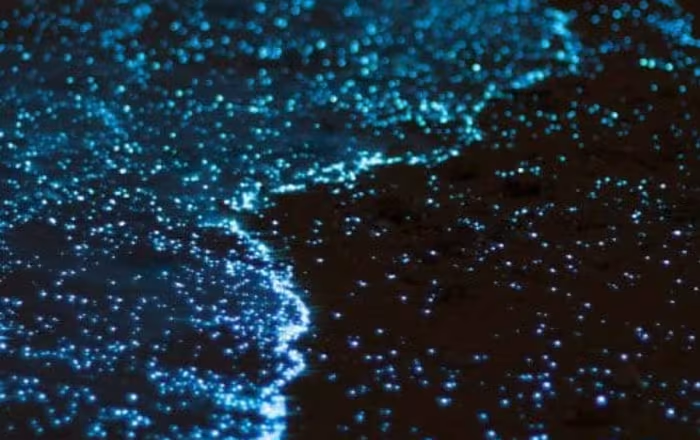
The glow is always faint compared with daylight. In Manialtepec Lagoon it comes mostly from dinoflagellates, single-celled plankton that give a very short flash when the water around them moves. At sunset the sky is still thousands of times brighter than those flashes, so you can stir the water and see nothing at all.
As twilight fades, you may first notice a few pale sparks in the shadow of the mangroves. A little later, the same water shows clear trails behind a hand or a paddle. The plankton did not arrive in those minutes. The background simply got dark enough for you to see them.
What time it gets dark in Puerto Escondido
Sunset moves by a bit more than an hour over the year on this coast. These are approximate local times:
- Late November and December: the sun sets around 6 PM, and it is fully dark by about 7 PM.
- March: sunset is a little before 7 PM, with full darkness around 8 PM.
- June and July: sunset is a little after 7 PM, and the last light lingers until around 8 PM or slightly later.
So in winter an early outing is already dark. Around midsummer, the first minutes on the water may still have some twilight, and the glow gets easier to see as the evening goes on. Clouds and the shade of the mangroves can bring that darkness forward.
Is bioluminescence brighter at midnight?
Not in a way you should plan your night around. Many glowing dinoflagellates follow an internal daily clock: their ability to flash is low during the day and builds up as night begins. In laboratory studies of some species, it is strongest well into the night. But a lagoon is not a laboratory, and we know of no measurements that give a best hour for Manialtepec.
What you notice on the water depends much more on the sky. A moonless 7:30 PM will usually look better than a midnight under a high, bright moon. And early evening is when boats, guides and hotel transfers are easiest to arrange.
The moon can change the best hour
The moon rises later each day, by a little under an hour on average, and that shifts the dark window all month long:
- Around new moon: the whole evening is dark. Any time after nightfall works.
- A few days after new moon: a thin crescent sits low in the west and sets early. It gets darker as the evening goes on.
- The week before full moon: the moon is already up at sunset and stays up until late. These are the hardest evenings.
- Full moon: it rises around sunset and stays all night. The glow looks softer.
- A few days after full moon: there is a dark gap between nightfall and moonrise, and the early evening is the time to go.
Check the moonrise and moonset times for your date, not only the phase. Our moon phase guide walks through each case.
What about late at night or before dawn?
The water can still glow in the small hours, and the moon works differently then. Just after new moon, the hours before dawn are moonless; just after full moon, the moon is still up until morning. Once daylight starts to return, the glow disappears from view again.
That does not make a 3 AM outing a good idea. Do not go into a lagoon or the sea on your own in the dark: you can't judge depth, currents or wildlife, and there is nobody to help. A guided trip earlier in the evening shows you the same living light.
What time our tour goes out
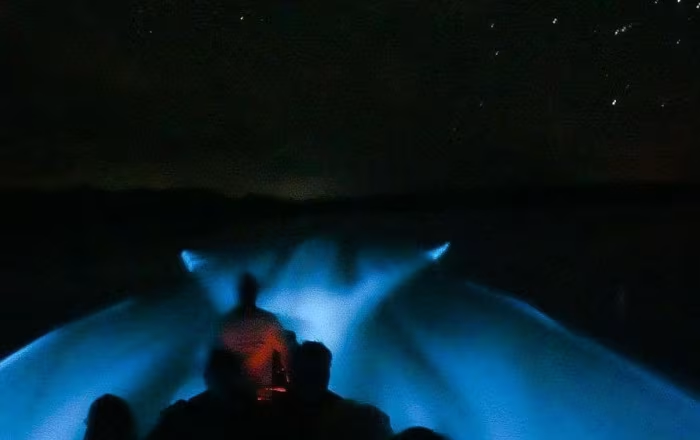
On the shared tour, we pick you up in Puerto Escondido at 6:30 PM, drive about 20 minutes and are on the water from around 7:00 PM. You spend about an hour on the lagoon, with swim time, then head back at about 8:15 PM and reach your hotel by 9:00 PM. It costs $950 MXN per person.
The private tour picks your group up at 5:30 PM, so you see the sunset on the lagoon first and then watch the glow appear as the sky darkens. It costs $8,000 MXN per boat, for up to 10 people. If you are deciding between the two, see private or shared tour.
How to see more at any hour
- Give your eyes time. Night vision improves a lot in the first 10 minutes and keeps improving for about half an hour.
- Keep screens and torches off. One look at a bright phone screen can set your eyes back several minutes.
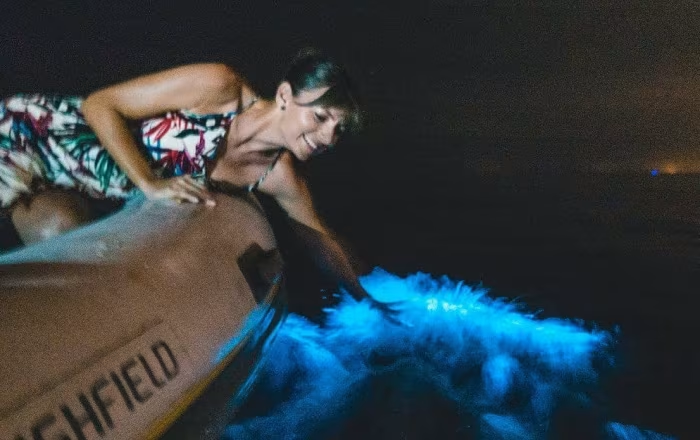
- Move the water. Still water stays dark. Sweep your arm or kick gently.
- Look into the shadows. The side of the boat away from the moon, or water under the trees, shows more.
- Skip sunscreen, lotion and repellent before swimming. They harm the plankton that make the light.
Quick answers
Can you see bioluminescence right after sunset?
Usually only faintly, if at all. Wait until twilight has mostly faded.
Does the glow stop after a few hours?
No. It goes on through the night. Our post on how long bioluminescence lasts explains the timing of a flash, a night and a season.
Does the month matter more than the hour?
Yes. The season, the recent rain and the moon make a bigger difference than the clock. The glow is usually strongest in the rainy months, roughly June to October. Before you choose your dates, read about the best time of year to see bioluminescence.